
When an X-ray baggage scanner displays the contents of a suitcase or parcel in different colors, it is doing more than simply creating an image. Modern security screening systems can analyze how different materials interact with X-rays and use this information to help security operators distinguish between organic, inorganic, and mixed materials.
One of the key technologies behind this capability is dual-energy X-ray technology.
But what exactly is dual-energy X-ray technology, how does it work, and why is it important for modern security screening?
In this article, we explain the basic principles of dual-energy X-ray imaging, its role in material discrimination, and how it can improve the efficiency and effectiveness of baggage and parcel inspection.
What Is Dual-Energy X-Ray Technology?
Dual-energy X-ray technology is an imaging method that uses X-ray information at two different energy levels to obtain more information about the materials inside a bag or parcel.
A conventional X-ray image primarily shows differences in X-ray attenuation. In other words, materials that absorb or block more X-rays appear differently from materials that allow more X-rays to pass through.
Dual-energy imaging goes a step further.
By comparing the way an object responds to different X-ray energy levels, the system can estimate material characteristics such as effective atomic number (Zeff). This additional information can then be used to classify materials into broad categories such as organic, inorganic, and mixed materials.
Research and technical development in dual-energy X-ray imaging have demonstrated its ability to provide material discrimination information beyond conventional single-energy imaging.
For security screening, this means operators can consider not only what an object looks like, but also what type of material it may be.
How Does Dual-Energy X-Ray Imaging Work?
The basic principle can be explained in several steps.
1. X-Rays Pass Through the Baggage
As a bag, parcel, or piece of cargo moves through an X-ray scanner, X-rays pass through its contents.
Different materials absorb X-rays at different rates depending on factors such as density, thickness, and atomic composition.
Dense materials such as metals generally attenuate X-rays strongly, while lower-density organic materials typically interact differently with the X-ray beam.
2. The System Collects X-Ray Information at Different Energy Levels
A dual-energy system obtains information corresponding to two different X-ray energy ranges.
The detector receives the X-rays that pass through the inspected object and produces signals representing the attenuation characteristics of the material.
3. The System Compares the Two Energy Responses
The important step is the comparison.
Instead of relying on a single X-ray measurement, the system analyzes the relationship between the responses at different energy levels.
This provides additional information that can be used to estimate the material’s effective atomic number and classify it into a material category.
4. Material Information Is Converted Into a Color-Coded Image
The processed information can then be displayed using different colors.
For example, modern security X-ray systems commonly use color categories to help operators distinguish between:
Organic materials — such as plastics, clothing, paper, food, and some substances of security concern
Inorganic materials — including many types of glass, ceramics, and other non-organic materials
Metals — such as weapons, tools, and other dense metallic objects
Mixed materials — objects or areas containing different material characteristics
The exact color mapping varies between systems and imaging modes.
In Safeagle’s X-ray systems, dual-energy technology is combined with multi-color imaging to help operators interpret the contents of baggage more efficiently.
Why Is Dual-Energy X-Ray Technology Important for Security Screening?
The biggest advantage of dual-energy technology is that it provides more information than a conventional single-energy X-ray image.
Security screening is not simply about seeing the outline of an object. Operators need to determine whether an object could represent a potential threat.
A bag may contain dozens of ordinary objects packed closely together. A weapon, suspicious substance, or other prohibited item may be partially hidden behind clothing, electronics, containers, or other materials.
Material discrimination gives operators another visual characteristic to consider.
Instead of asking only:
“What does this object look like?”
the operator can also consider:
“What type of material does this object appear to be?”
This additional information can make X-ray image interpretation more efficient.
5 Major Benefits of Dual-Energy X-Ray Technology
1. Better Material Discrimination
Material discrimination is one of the primary advantages of dual-energy X-ray imaging.
By analyzing X-ray responses at different energy levels, the system can help differentiate broad categories of materials.
For security operators, this means suspicious areas can be identified based on both shape and material characteristics.
This is particularly useful when objects have similar shapes but different compositions.
2. Easier Identification of Organic Materials
Organic materials can be difficult to distinguish using shape alone.
Common everyday objects such as clothing, food, plastic containers, paper, and other low-density materials may appear together inside a bag.
Dual-energy technology provides additional material information that helps separate organic materials from inorganic materials and metals.
This capability is especially relevant in security screening because certain threat materials can also fall within organic material ranges.
However, an important distinction should be made: an X-ray scanner’s material classification or threat-assistance function is not the same as chemical identification.
Advanced X-ray systems can assist operators by highlighting materials within specific characteristics or Zeff ranges, but suspicious items may still require secondary inspection or other detection technologies.
3. Improved Color-Coded Imaging
Dual-energy technology provides the foundation for advanced material-based color imaging.
Instead of displaying every object using only grayscale intensity, modern security scanners can assign colors according to material characteristics.
This allows an operator to quickly distinguish different types of objects within a complex X-ray image.
For example, Safeagle’s systems use multi-color imaging to display different material ranges. Its HP-SE100100C supports switchable 4-color and 7-color imaging, with colors corresponding to specific atomic-number ranges.
For an operator who needs to inspect hundreds or thousands of bags or parcels, this visual differentiation can make image interpretation faster and more intuitive.
4. More Efficient Threat Screening
Modern security screening depends on both technology and trained human operators.
The X-ray system generates and processes the image, while the operator interprets the information and decides whether additional inspection is required.
Dual-energy imaging provides operators with another layer of information.
Instead of relying only on:
Object shape
Object density
Object position
Image contrast
operators can also consider:
Material category
Effective atomic number characteristics
Color-coded material information
Suspicious material combinations
This multi-dimensional information can help security personnel focus their attention on areas that deserve further inspection.
5. Better Performance in Complex Baggage Images
Real-world baggage is rarely neatly organized.
A suitcase may contain clothing, electronics, bottles, metal objects, books, food, and other personal belongings packed together.
Objects can overlap, creating complicated X-ray images.
Dual-energy imaging and advanced image-processing functions can help separate material categories and improve visual interpretation.
This does not eliminate the need for trained operators, but it can provide them with better information when examining cluttered baggage.
Dual-Energy X-Ray vs. Single-Energy X-Ray
So, what is the difference between single-energy and dual-energy X-ray imaging?
| Feature | Single-Energy X-Ray | Dual-Energy X-Ray |
|---|---|---|
| X-ray information | One energy range | Two energy ranges |
| Basic imaging | Yes | Yes |
| Material discrimination | Limited | Enhanced |
| Organic/inorganic classification | Limited | Supported |
| Effective atomic number information | Limited | Can be estimated |
| Color-coded material imaging | Limited | Advanced |
| Operator information | Primarily shape and density | Shape, density, and material characteristics |
| Security screening capability | Basic | More advanced |
The key difference is the amount of material information available to the operator.
Dual-energy does not simply make an X-ray image “brighter” or “clearer.” Its primary advantage is that it provides additional information about the materials being inspected.
Dual-Energy X-Ray and 7-Color Imaging: What’s the Connection?
Dual-energy and 7-color imaging are related, but they are not exactly the same technology.
Dual-energy refers to the X-ray imaging method used to obtain material-related information.
7-color imaging refers to how the processed information is represented visually on the operator’s screen.
In other words:
Dual-energy → material information → image processing → color-coded display
The color display makes complex material information easier for operators to interpret.
Some advanced X-ray baggage scanners allow operators to switch between different color modes depending on the inspection task.
For example, Safeagle’s HP Series supports switchable 4-color and 7-color imaging. The HP-SE100100C also provides organic, inorganic, and mixture stripping functions for additional image analysis.
What Is Zeff in Dual-Energy X-Ray Screening?
Zeff, or effective atomic number, is an important concept in material discrimination.
Different materials contain different combinations of elements. Their X-ray attenuation behavior changes according to their composition and other physical characteristics.
Dual-energy X-ray systems can use the relationship between high- and low-energy X-ray attenuation to estimate effective atomic number information.
This allows the system to classify materials into broader categories.
For example, Safeagle’s HP-SE100100C uses Zeff-based assistant detection functions to highlight potential hazardous liquids and potential explosive or narcotic materials within specified Zeff ranges.
This should be understood as detection assistance rather than laboratory-level material identification. The technology helps operators locate and evaluate suspicious areas, while final security decisions may involve additional inspection procedures.
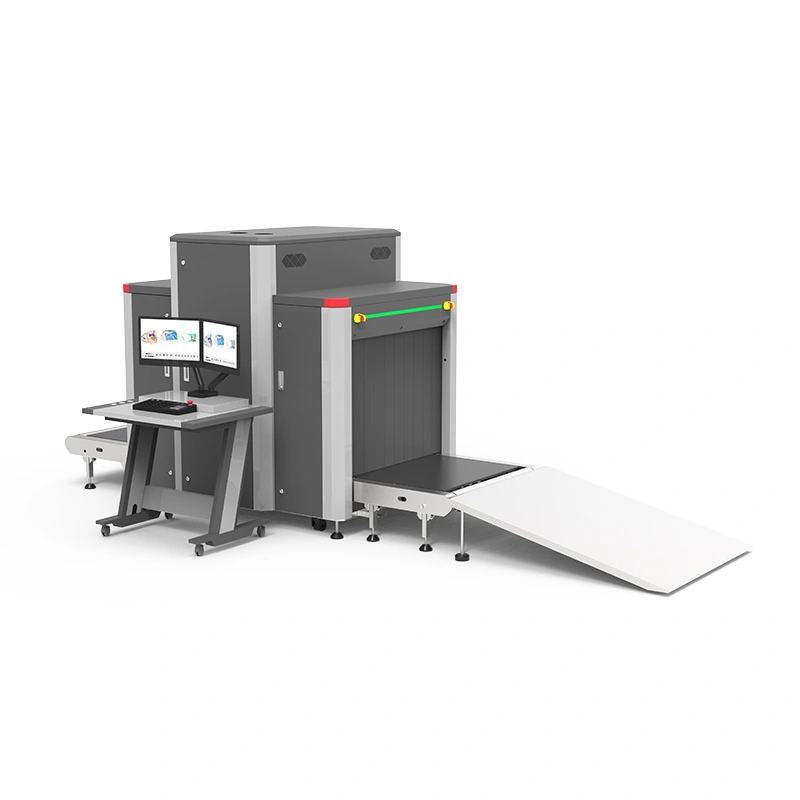
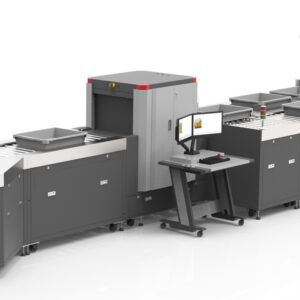
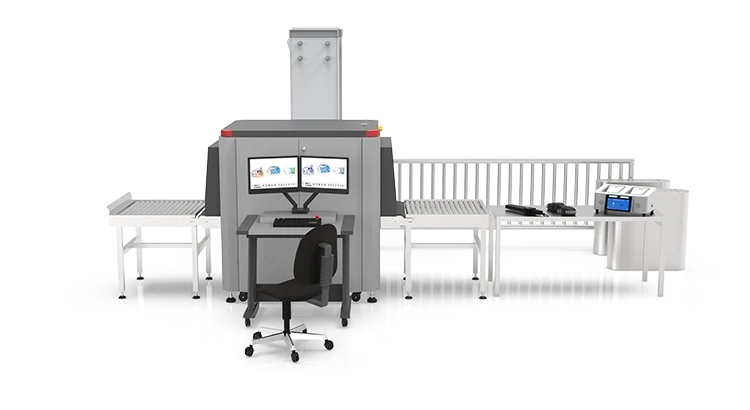
Safeagle HP-SE100100C: Large X-Ray Screening with Dual-Energy Technology
For facilities that need to inspect large baggage, parcels, or cargo, a standard airport carry-on baggage scanner may not provide enough tunnel space.
This is where the Safeagle HP-SE100100C Large X-ray Screening System can be useful.
The HP-SE100100C is designed for large-object and cargo screening and features a 1001 × 1001 mm tunnel, allowing significantly larger items to pass through the inspection system. Its conveyor supports loads up to 250 kg, making it suitable for applications where large parcels or cargo need to be inspected.
Key HP-SE100100C Features
The system combines dual-energy technology with several image-processing and screening functions, including:
Switchable 4/7-color imaging
Real-time image processing
Organic, inorganic, and mixture stripping
Hazardous liquid detection assistance
Explosive and drug detection assistance
Thin object scanning
Splicing scanning
Dual-energy imaging
40 AWG wire detectability
Up to 36 mm typical steel penetration
The system uses a 140 kV X-ray generator, with a 160 kV option available, and features a sealed oil bath with forced-air cooling. Its design provides a 100% duty cycle without a warm-up procedure.
These specifications make the HP-SE100100C particularly suitable for applications where both large inspection capacity and advanced material discrimination are important.
Potential applications include:
- Airport cargo screening
- Customs inspection
- Border checkpoints
- Logistics centers
- Railway stations
- Government facilities
- Military installations
- High-risk facilities
- Large parcel and cargo inspection
Safeagle also lists the HP-SE100100C among its large-aperture X-ray inspection systems designed for large cargo, checked luggage, and other oversized objects.
View the Safeagle HP-SE100100C Large X-Ray Screening System
Does Dual-Energy X-Ray Detect Explosives?
Dual-energy X-ray technology can assist in identifying materials that have characteristics associated with potential threats, but it should not be described as a universal chemical detector.
Some advanced systems analyze material characteristics and highlight suspicious regions according to predefined ranges.
For example, the Safeagle HP-SE100100C includes Zeff-based assistant detection for potential explosive and narcotic materials within specified ranges.
However, X-ray screening and explosive trace detection serve different purposes.
An X-ray scanner primarily provides non-invasive imaging and material-discrimination information, while an explosive trace detector is designed to detect trace residues of specific substances.
For high-security applications, these technologies can therefore complement each other as part of a layered security strategy.
Does Dual-Energy X-Ray Improve Security Screening Accuracy?
It can improve the information available to security operators, but technology alone does not guarantee perfect detection.
Actual screening performance depends on multiple factors, including:
- X-ray image quality
- Material discrimination capability
- X-ray penetration
- Spatial resolution
- Image-processing software
- Baggage organization and concealment
- Operator training
- Screening procedures
- Secondary inspection capabilities
This is why modern security screening should be viewed as a combination of advanced equipment + software + trained personnel + appropriate procedures.
Research into dual-energy baggage inspection has shown that the additional information obtained from high- and low-energy X-ray measurements can support material classification and improve image interpretation compared with relying on a single energy measurement.
How to Choose a Dual-Energy X-Ray Baggage Scanner
If you are purchasing an X-ray screening system for an airport, logistics center, customs facility, or other high-security environment, dual-energy capability is only one factor to consider.
You should also evaluate:
1. Tunnel Size
Make sure the tunnel is large enough for the biggest items you need to inspect.
For large cargo and oversized parcels, a 1000 × 1000 mm-class tunnel can provide substantially more flexibility than a standard baggage scanner.
2. Steel Penetration
Higher penetration capability can be important when inspecting dense or heavily packed objects.
The HP-SE100100C, for example, provides 36 mm typical steel penetration.
3. Spatial Resolution
Good spatial resolution helps operators identify small components, wires, and fine structures.
4. Material Discrimination
Look for systems that support dual-energy imaging and organic/inorganic material differentiation.
5. Image Processing
Features such as image enhancement, stripping, zoom, reverse scanning, and multi-screen viewing can significantly affect operator efficiency.
6. Conveyor Load Capacity
Large cargo screening requires a conveyor designed for heavy loads.
7. After-Sales Support
A security scanner is a long-term investment. Technical training, remote support, software updates, spare parts, and engineering assistance can be just as important as the initial equipment specification.
Frequently Asked Questions About Dual-Energy X-Ray Technology
What is dual-energy X-ray technology?
Dual-energy X-ray technology uses X-ray information at two different energy levels to obtain additional information about the materials inside baggage or parcels. This information can help classify materials according to characteristics such as effective atomic number.
What is the main advantage of dual-energy X-ray?
The main advantage is improved material discrimination. Operators can use information about material characteristics in addition to object shape and density when interpreting an X-ray image.
Can dual-energy X-ray distinguish organic and inorganic materials?
Yes. Dual-energy X-ray systems can support classification of materials into broad categories such as organic, inorganic, metal, and mixed materials, depending on the system’s imaging algorithms and configuration.
Why do X-ray baggage scanners use different colors?
Different colors can represent different material or atomic-number ranges. Color-coded imaging helps security operators quickly interpret complex X-ray images and identify areas that may require closer examination.
Is dual-energy X-ray the same as 7-color imaging?
No. Dual-energy describes the imaging technique used to obtain additional material information, while 7-color imaging describes how processed material information is displayed on the screen.
Can dual-energy X-ray detect explosives?
Dual-energy X-ray can assist in identifying materials with characteristics associated with potential explosive threats. However, it is not equivalent to chemical or explosive trace detection. Suspicious items may require additional inspection.
Is dual-energy X-ray better than single-energy X-ray?
For many security screening applications, dual-energy provides more material-related information than single-energy imaging. This can help operators interpret baggage more effectively, particularly when multiple materials overlap.
Conclusion: Why Dual-Energy Matters in Modern Security Screening
Dual-energy X-ray technology represents an important development in modern baggage and parcel inspection.
Instead of relying only on the shape and density of objects, dual-energy imaging provides additional information about their material characteristics. When combined with color-coded imaging, image enhancement, penetration capability, and trained operators, it can make security screening more informative and efficient.
For facilities handling large parcels or cargo, the Safeagle HP-SE100100C Large X-ray Screening System combines dual-energy imaging with switchable 4/7-color imaging, material stripping, Zeff-based detection assistance, a 1001 × 1001 mm tunnel, and a 250 kg conveyor load capacity.
As security environments become more complex, technologies that provide operators with more information—not simply more images—will continue to play an important role in modern security screening.
For organizations looking for a large-aperture dual-energy X-ray screening system, Safeagle provides X-ray inspection solutions for cargo, baggage, parcels, transportation facilities, customs, logistics centers, government facilities, and other high-security applications.


Looking For Security Inspection Solutions?
As an excellent manufacturer providing full public safety solutions. Our product range includes X-ray Baggage Scanners, Walk-Through Metal Detectors, Handheld Metal Detectors, and Vehicle Inspection Systems, etc.
Need help selecting the right equipment? Contact our team to discuss your application and request a customized solution.