
As global security demands continue to escalate, the X-ray baggage scanner market is undergoing a significant wave of technological iteration. According to industry reports, the global security scanning equipment market reached approximately USD 14 billion in 2025, and is projected to grow to USD 28.2 billion by 2035, representing a compound annual growth rate of approximately 7.2%. Meanwhile, AI-driven threat detection, 3D imaging, and automated tray return systems are redefining the standards of “efficient security screening.”
For procurement decision-makers at airports, rail transit systems, large venues, and commercial complexes, how to filter out X-ray baggage scanners that truly adapt to their specific scenarios from numerous options has become a technical task requiring systematic evaluation. This article compiles an actionable procurement framework from four dimensions: technological evolution, scenario matching, core indicators, and after-sales support.

Technology Trends: From “Visible” to “Accurate and Fast”
Traditional X-ray baggage scanners primarily rely on dual-energy imaging to distinguish organic, inorganic, and mixed materials through color coding. This technological approach remains the primary solution for small and medium-sized scenarios, with its core value lying in short operator training cycles and high equipment maintenance maturity.
However, in the face of increasingly sophisticated concealment methods and higher passenger flow pressures, the industry is evolving in two directions:
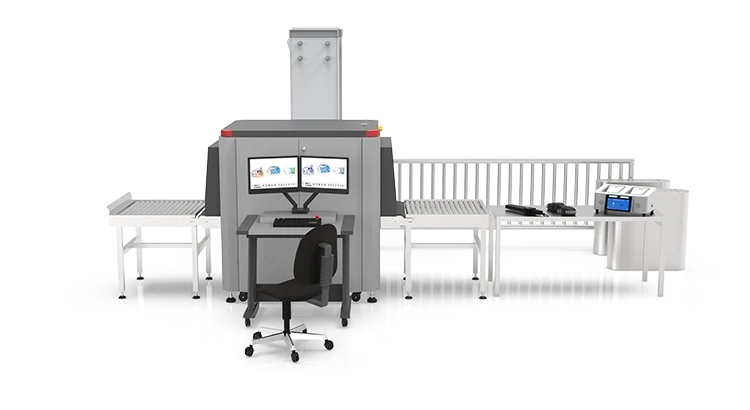
First, multi-view imaging. Single-view equipment is prone to blind spots when dealing with overlapping items, requiring operators to repeatedly adjust package angles or even conduct manual re-inspection. Dual-view X-ray machines simultaneously image from horizontal and vertical directions, effectively reducing missed detections caused by occlusion.
Second, 3D vision and AI-assisted identification. Since 2025, the penetration of 3D imaging technology in the security screening field has accelerated significantly. The 3D TriEye Vision technology, for example, can output three synchronized high-definition views in a single scan. Combined with AI algorithms, the interpretation time per baggage item can be compressed to approximately 2 seconds, significantly reducing re-inspection rates. This direction aligns with the broader global trend of intelligent security screening equipment: AI algorithms assisting in the analysis of anomalies in X-ray imaging are becoming key to improving detection consistency and efficiency.
Different Applications Require Different “Problem-Solving Approaches”
The most common misconception when purchasing X-ray baggage scanners is directly targeting the “highest configuration.” In reality, airports, rail transit, logistics parcels, and commercial building visitor baggage screening have significantly different equipment requirements.
Airports and rail transit typically focus on balancing throughput efficiency and detection rates. Tunnel size is the primary parameter: equipment with 50-100cm tunnels accommodates standard carry-on baggage and holds approximately 48.25% of the market share. For high-traffic hub stations, high-speed conveyor systems can be optionally configured to support conveyor speeds of up to 1.0m/s, representing an order-of-magnitude improvement over conventional equipment speeds of 0.22m/s.
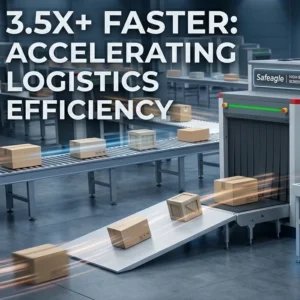
Logistics and freight scenarios place greater emphasis on penetration power and tunnel size. Large tunnel models such as 1810×1814mm can accommodate pallets and large cargo items, with dual-view imaging further reducing detection blind spots caused by cargo stacking.
Commercial buildings and venues often have limited space, making compact equipment more suitable. However, “compact” does not mean “low-capability”—7-color imaging, hazardous liquid auxiliary detection, and explosive and narcotic atomic number annotation functions can also be integrated on small and medium-sized equipment, helping non-professional operators make more accurate judgments under limited training conditions.
Quality and After-Sales Support Matter More Than Specification Sheets
During the inquiry stage, procurement teams tend to focus on paper specifications such as X-ray generator voltage and wire resolution. However, the actual performance of equipment after deployment largely depends on two easily overlooked dimensions.
First, long-term stability and radiation safety compliance. X-ray baggage scanners are regulated ionizing radiation devices and must comply with the safety standards of target markets. Chinese GB15208 series standards, American ANSI N42.44, and relevant EU technical specifications all have clear requirements for radiation safety, electrical safety, and image performance. Choosing manufacturers with compliance certifications and mature quality control systems is fundamental to avoiding later regulatory risks.
Second, after-sales service accessibility and response speed. Once security equipment goes down, it directly affects the continuity of venue operations. Industry research shows that imported equipment may face 6-12 week spare parts waiting periods in some regions, which is unacceptable at critical security checkpoints. Therefore, examining whether suppliers have regional spare parts warehouses, local technical support capabilities, and clear warranty terms should be equally important as equipment parameter evaluation.
How to Determine Whether a Security Equipment Manufacturer is “Reliable”
After completing technical screening and scenario matching, the final decision often returns to one question: Is this supplier worth long-term cooperation?
Here are several practical evaluation angles:
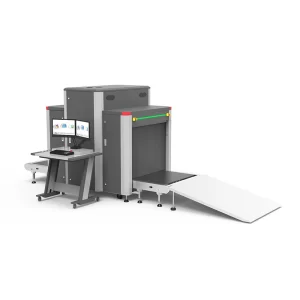
Examine product line completeness and iteration pace. A manufacturer that continuously invests in research and development will show a clear evolutionary logic in its product series. Taking Safeagle as an example, its HP series ranges from conventional dual-energy models to 3D TriEye Vision, and then to configuration options supporting high-speed conveyors, reflecting continuous response to market demands.
Examine actual export coverage. Security equipment belongs to a category with significant differences in market access standards across countries. The ability to consistently deliver to multiple countries and regions itself demonstrates that its product adaptability and compliance experience have been tested.
Examine communication efficiency. During the inquiry stage, whether suppliers can provide targeted configuration recommendations for specific scenarios rather than simply listing parameters often predicts the smoothness of subsequent cooperation.
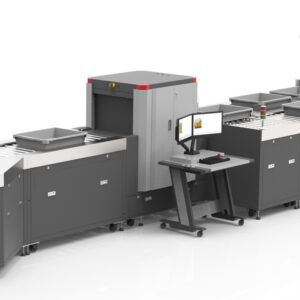
For institutions planning security equipment procurement or upgrades, the most effective path is not to chase “the latest technology,” but to return to your own throughput, space conditions, operator staffing, and budget cycle to find the solution with the highest degree of matching. As an X-ray security equipment manufacturer with over a decade of production experience, Safeagle’s product range covers a complete matrix from compact models to large dual-view systems, and can provide configuration recommendations and technical solutions based on specific application scenarios.
For further information on equipment selection suitable for your location, please visit safeagle.com to view product details, or contact the team directly at sales@safeagle.com.


Looking For Security Inspection Solutions?
As an excellent manufacturer providing full public safety solutions. Our product range includes X-ray Baggage Scanners, Walk-Through Metal Detectors, Handheld Metal Detectors, and Vehicle Inspection Systems, etc.
Need help selecting the right equipment? Contact our team to discuss your application and request a customized solution.