
As global infrastructure expands—across airports, metro transit systems, customs checkpoints, logistics hubs, and commercial venues—the demand for reliable, cost-effective security screening has grown steadily. Today, China has become one of the world’s primary manufacturing hubs for X-ray baggage scanners and integrated security inspection equipment, supplying both public-sector tenders and private commercial projects worldwide.
For international distributors, security system integrators, and procurement managers, understanding both the underlying technology of X-ray inspection and the criteria for evaluating Chinese manufacturers is essential to making an informed purchasing decision.

How Modern X-Ray Baggage Scanners Work
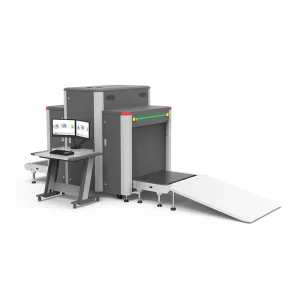
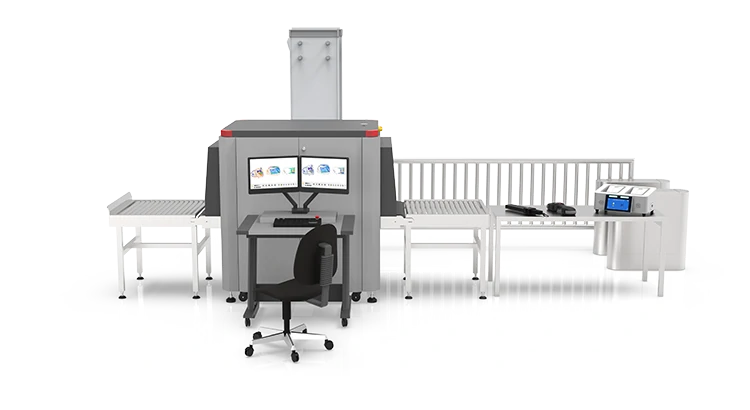
An X-ray security scanner does far more than generate a black-and-white silhouette of a bag. Modern systems rely on dual-energy X-ray imaging and real-time image processing algorithms to help operators distinguish between organic, inorganic, and metallic materials.
Core Components of an X-Ray Security System
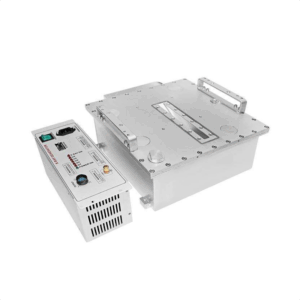
X-Ray Generator: Produces a controlled, collimated fan beam of X-rays. Key performance metrics include tube voltage (typically ranging from 80 kV to 160 kV+ depending on penetration needs) and cooling efficiency for continuous 24/7 operation.

(X-ray Generator) L-Shaped Detector Array: Positioned opposite the generator, dual-layer photodiode detectors capture X-ray photons after they pass through the luggage. One layer absorbs low-energy photons, while the second captures high-energy photons.
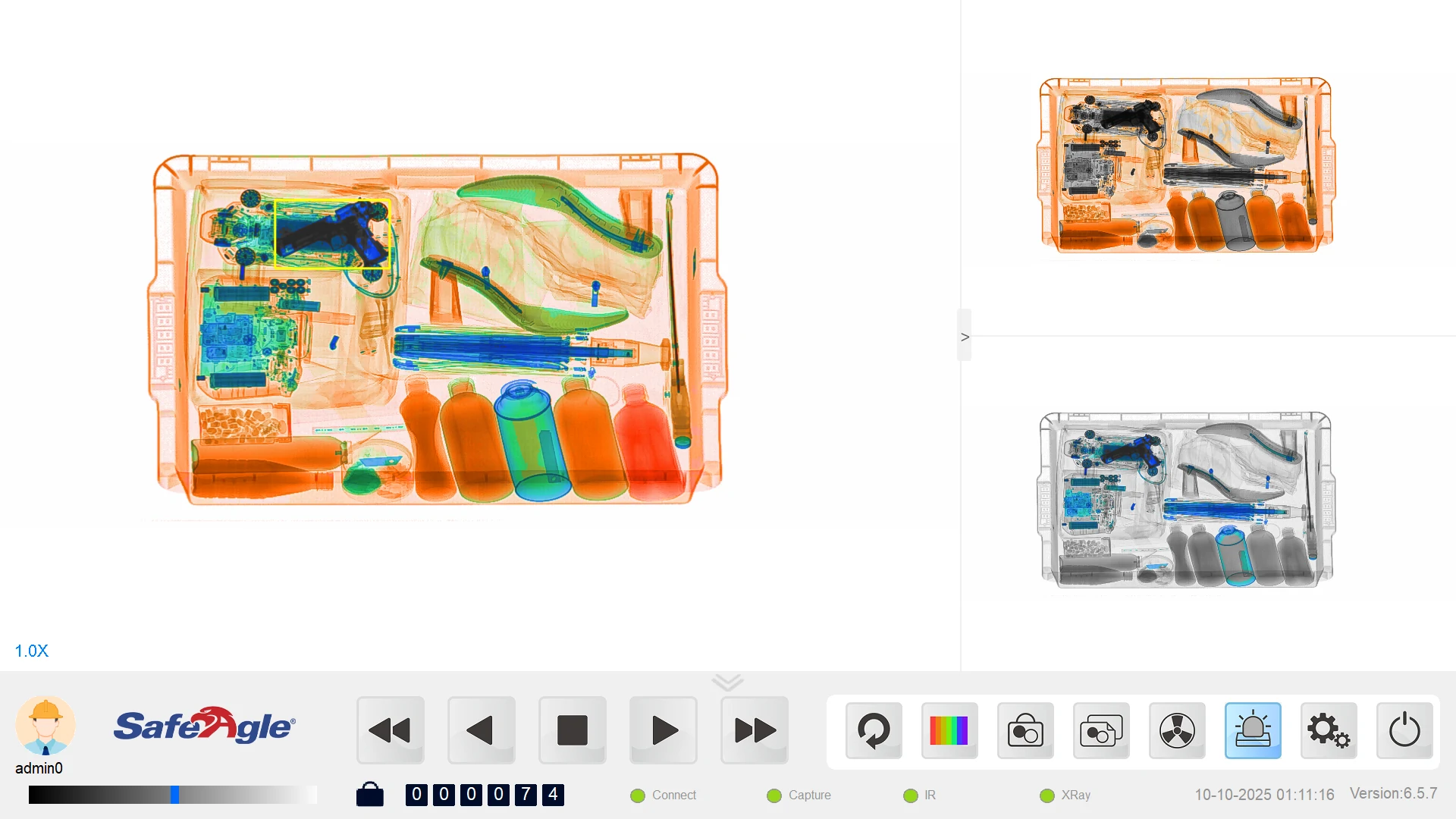
Material Discrimination & Color Coding: By comparing the attenuation ratio between high- and low-energy signals, the system calculates the effective atomic number (Zeff) of items inside the bag and assigns standard industry colors:
Orange: Organic materials (explosives, narcotics, food, paper, textiles).
Blue: Inorganic and dense metallic materials (weapons, knives, dense alloys).
Green: Mixed materials or light metals (aluminum, electronics, composite items).
Radiation Shielding & Safety Interlocks: Lead curtains at the tunnel entrance and exit, steel housing, and fail-safe interlock switches ensure external radiation leakage remains strictly below international safety thresholds (typically under 1µSv/h at 5 cm from the exterior housing).
Key Technical Specifications Buyers Should Compare
When comparing X-ray baggage scanners from different suppliers, looking only at the tunnel size can be misleading. Procurement teams should evaluate four core technical indicators:
| Specification | What It Measures | Why It Matters in Operations |
| Tunnel Dimensions | Width × Height of the inspection chamber (e.g., 5030, 6550, 100100) | Determines whether the machine fits hand luggage, large suitcases, or palletized cargo. |
| Steel Penetration | Maximum thickness of steel plate the X-ray beam can penetrate (e.g., 30 mm – 40 mm+) | Higher penetration ensures dense objects inside thick luggage are clearly visible without blind spots. |
| Wire Resolution | The thinnest single copper wire visible on the monitor (e.g., 38 AWG or 40 AWG) | Higher AWG numbers indicate sharper image clarity for detecting fine detonator wires. |
| Conveyor Load & Speed | Maximum weight capacity (e.g., 150 kg – 200 kg+) and belt speed (typically ~0.22 m/s) | Directly impacts passenger throughput and suitability for heavy freight or logistics centers. |
Why Global Buyers Source Security Inspection Equipment from China
Over the past two decades, China’s security inspection manufacturing sector has evolved from basic assembly into vertically integrated R&D and precision production. International buyers typically look to Chinese manufacturers for three main reasons:
Complete Supply Chain & Customization: Leading Chinese factories maintain in-house capabilities for mechanical fabrication, X-ray control boards, imaging software, and lead shielding, allowing faster customization of tunnel sizes, conveyor extensions, and local voltage configurations.
Scalable Cost-to-Performance Ratio: Buyers can access dual-energy imaging, Threat Image Projection (TIP), and AI-assisted threat recognition at a significantly lower total cost of ownership (TCO) than legacy Western brands.
One-Stop Multi-Product Integration: Rather than sourcing X-ray scanners, walk-through metal detectors, and vehicle barriers from separate vendors, buyers can consolidate procurement with manufacturers that offer a unified security ecosystem.
How to Evaluate a China X-Ray Baggage Scanner Supplier
Not all suppliers in China operate at the same engineering or quality-control level. Before shortlisting a manufacturer, buyers should verify the following checkpoints:
Manufacturing vs. Trading Capability: Confirm whether the company operates its own production lines, R&D engineering team, and radiation testing facilities rather than acting purely as a trading intermediary.
International Compliance & Quality Systems: Look for documented adherence to ISO 9001 quality management, CE conformity, FCC compliance, and radiation safety standards aligned with FDA / IAEA guidelines.
Product Ecosystem Breadth: Security checkpoints rarely rely on a single device. A strong manufacturer should understand how X-ray baggage scanners work alongside walk-through metal detectors, handheld metal detectors, explosive trace detectors (ETD), and perimeter vehicle screening systems.
After-Sales & Spare Parts Support: Verify remote diagnostic capabilities, availability of modular spare parts (such as detector boards, power supplies, and conveyor motors), and clear warranty terms for overseas deployments.
Example of a Full-Range Security Equipment Manufacturer: Safeagle
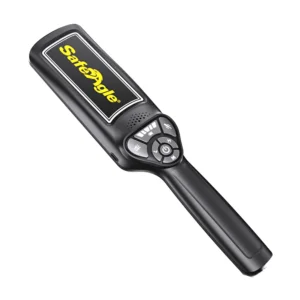
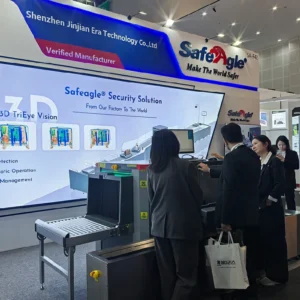
For buyers seeking a specialized manufacturer in China with end-to-end checkpoint capabilities, Safeagle represents the integrated manufacturing model in this sector. Rather than focusing on a single standalone product, Safeagle develops and supplies a complete lineup of security inspection and perimeter protection systems—including X-ray Baggage Scanners, Walk-Through Metal Detectors(WTMD), Hand-Held Metal Detectors, Explosive Trace Detectors (ETD), Under Vehicle Inspection System (UVIS). This breadth allows system integrators and distributors to standardize maintenance, spare parts, and technical support across multi-layered security projects.

Frequently Asked Questions (FAQ)
What tunnel size is most common for commercial buildings and hotels?
For offices, hotels, schools, and shopping malls, compact to medium tunnel sizes such as 5030 (500 mm × 300 mm) or 6550 (650 mm × 500 mm) are standard. They easily accommodate backpacks, briefcases, and standard carry-on luggage while fitting through standard commercial doorways.
Are X-ray baggage scanners safe for operators and electronic devices?
Yes. Modern X-ray scanners are designed with multi-layer lead shielding and automatic safety interlocks so operators can stand beside the machine safely during normal shifts. In addition, the low-dose X-ray beam is safe for laptops, smartphones, cameras, and standard digital storage media.
Can one Chinese supplier provide both checkpoint screening and vehicle access control?
Yes. Integrated manufacturers such as Safeagle supply both personnel/parcel screening equipment (X-ray scanners, metal detectors, explosive trace detectors) and high-security vehicle perimeter hardware (under-vehicle scanners, hydraulic road blockers, and tire killers), simplifying project logistics for turnkey security contractors.


Looking For Security Inspection Solutions?
As an excellent manufacturer providing full public safety solutions. Our product range includes X-ray Baggage Scanners, Walk-Through Metal Detectors, Handheld Metal Detectors, and Vehicle Inspection Systems, etc.
Need help selecting the right equipment? Contact our team to discuss your application and request a customized solution.